(Pix: Divya & Bala)

The path to the lake

The first glimpse of the lake

The ugly ducklings transforming?
In another effort to upgrade the traffic conditions in Pune, the Bus Rapid Transit (BRT) was recently introduced on the Hadapsar-Swargate-Katraj route. BRT requires that the buses have a right-of-the-way lane. Separate dedicated lanes are meant to ensure punctuality, even during peak traffic hours. The ticket system is electronic, as in Pune’s case, to decrease the time of ticketing. It could also be pre-boarding ticketing for the same reasons. This is what an ideal BRT would include.
BRT is an ambitious project and might ease the traffic situation in Pune, which has deteriorated drastically over the last decade. The rapid growth of the city lead to increased residents and parallel growth in number of personal use vehicles. The public transport system which was hardly commendable was neglected further and still struggles to find its footing. The narrow roads in the city could not keep up with the increase in traffic and excessive vehicular pressure led to deteriorating road conditions. Over the last couple of years there have been consistent demands to alleviate the situation but almost nothing seems to have worked. N number of projects were promised, introduced, inaugurated and died their own death. Most of them tried to attract commuters to public transport and away from private vehicle usage to ease the burden on the roads. Projects like “Janata bus” (you wave out to the bus and it would stop almost anywhere you want it to, and the fares were also minimal), induction of new superior quality buses, plans to merge the PMT and PCMT, sky-bus etc. are just a few recent examples. The progressively deteriorating condition of the roads, the constant poor quality asphalting, potholes with the first rains and increased accidents have all made most of the citizens skeptical about any new programs that the PMC introduces to ease out things.
The timing of the BRT is also no better. It is less then four months before the PMC elections. The haste with which an approximate Rs.64 crore project is being implemented cannot be expected to create confidence and excitement among commuters. To many it came as a surprise pre-election do-good project. It seems more to be another of the Kalmadi projects. Pawar on the other hand is pushing for a metro system for Pune on the lines of
As someone who is well aquatinted with the traffic conditions in Pune, I am not optimistic about the project. One, the BRT takes off an entire lane to itself on roads which are hardly three complete lanes. Most of the roads in Pune are extremely narrow to fit even the existing traffic, and banning maximum vehicles from one entire lane would make matters no better. The current stretch of the pilot project includes Swargate. On any given day Swargate is choked. Being an important ST and PMT bus junction, it bring along rickshaws, road hawkers, ‘tapirs’, restaurants, lodges, chaos, accidents, pollution…you name it. In such an unruly situation taking away vehicular space from others might just aggravate matters. The traffic in Pune is also not disciplined. Commuters hardly ever stand at a bus-stop. You will always find them out on the road, waiting, fidgeting impatiently for the buses. Now taking the bus track and the bus stop towards the divider side of the road seems like a dangerous proposition. Other vehicles which might want to cross or make a U-turn at places will be left waiting for an opportunity in the second lane. Generally those turning right are supposed to be towards the extreme right lane i.e towards the divider side which the BRT will now take up. The buses (each costing around Rs.70 lakhs) are said to be low rise volvo buses. Given the number of potholes and bumps I do not know how low rise buses would survive.
Of course it does not mean that the project is totally hopeless. It might actually help bring lane discipline and overall traffic manners to the otherwise notorious Pune drivers. If the buses do run fast, frequent and on time, personal vehicle usage at least among some section of the commuters can be expected to decrease. The transport authority could probably hope of a no profit no loss situation, instead of the current deficit. As the new buses are said to have a better technology we can assume that they might be safer than the antique buses that currently run on the roads. Also as they would have closed doors, incidents of accidents due to hanging at the doors could go down.
We will have to wait and watch over the pilot period if it actually benefits the public. Unless elections kill it.
Fall is a pretty season. Not just because it paints a beautiful landscape. It also provides wholesome bird-watching opportunity! And no girl would disagree.
The weather in fall is moderately cold (nights can get really bad, but then acche bacche don’t stay out late nights!), and warm clothing is essential. And that’s where the fun begins. Back home in Pune, I don’t remember having bought multiple sweaters or having worn them for more than 20 days of the entire winter season. Unless you are traveling early morning or late night, you hardly need a sweater. In school, which was an afternoon session, I didn’t even have a sweater! It would be pleasant. ‘Gulabi thandi’ for those who know what I mean.
The cold weather that I have experienced here is different and currently restricted only to Fall. And I am looking forward to winter. Snow is a major attraction. But an even greater attraction is winter fashion! Over the last two months since temperatures started dropping, every day has been a treat to my fashion buds. Girls here know how to look pretty even in minus temperatures! The range of winter fashion that I have experienced here, and tempted to buy is awesome. The variety of overcoats, jackets, sweaters, scarves, caps, gloves, shoes….. magnificent! I remember wearing either regular black front-open sweater or pullovers back home. I hardly knew anything else beyond that. A denim jacket or a windcheater at the most. But then winters were never so cold. Here I see girls in all hues and shades, dressed up in lovely sweaters, overcoats, boots, scarves and caps. They look both cozy and stylish. On any given day at the 7.00AM bus, a girl so dressed up would enter, carefully remove her overcoat and gloves and wear them again as her stop comes closer. And all this without disturbing her hair, makeup, or getting conscious about people watching. I could never have imagined taking off my sweater without spoiling my hairdo. This means it stayed there no matter how warm, or I removed it without bothering about the hair.
Probably it is the moderation of Fall that allows them to do that. Perhaps winters would be different. Perhaps they only look warm. Perhaps someday I would have the entire range of winter clothes and look as composed and elegant even in snow! {Hint* Hint* ;) }
(Pix: Bala)
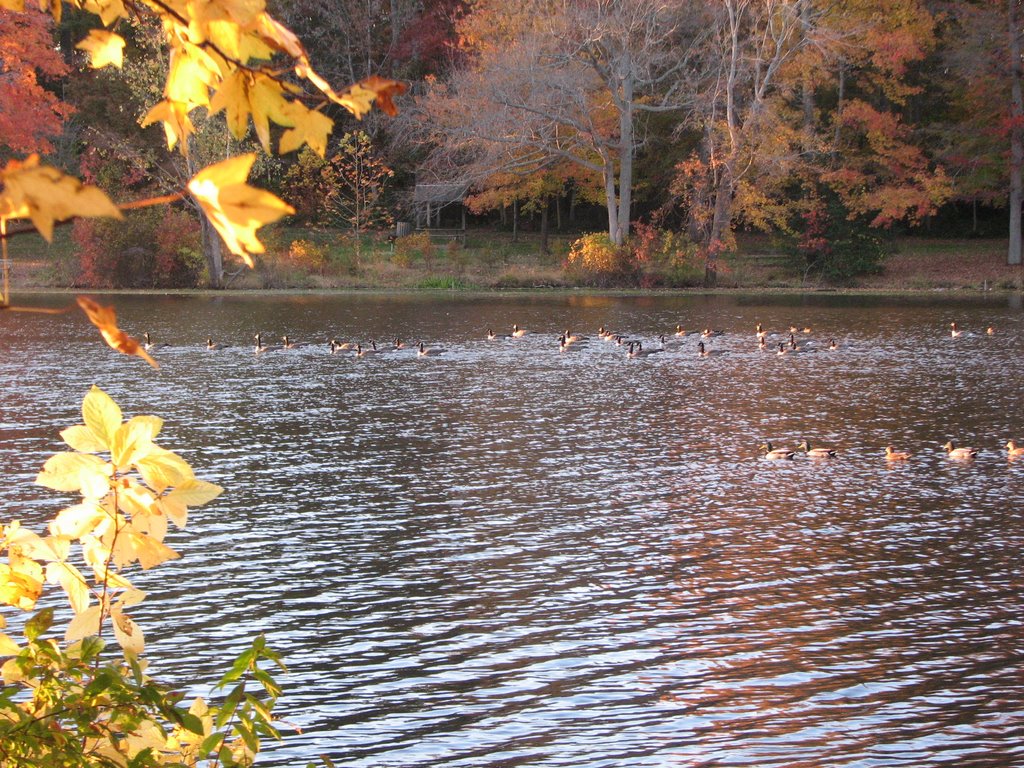
I am in love! The weather is awesome. I can feel the wind through my hair tickling the nerve endings. The ripples in the lake carry fall colors to the banks. The ducks slide along smiling. The bench amidst trees makes me skip a heartbeat. I trod over fallen leaves. They miss you.
The first thing that comes to our mind when we hear the word radical Islam, is terrorism. It brings to mind the picture of an AK47 sporting Muslim guy who kills for religious reasons. The media has fed us with so much of ‘jihad' that it is difficult to think of radical groups as anything but driven by and killing for a religion. However, today I heard a talk by Eli Berman that gave me an economic and sociological perspective into the motives behind the formation and development of a radical group.
Berman’s mainly argued that ‘God’ or ‘religion’ is not the central motive of a member of a radical* group**. Instead the motives are altruistic. Ariel Morari, an Israeli psychiatrist studied suicide bombers and their families to conclude that they do not mention religion and heaven/afterlife as their motives. Neither is the primary motive seeking revenge for a personal attack nor economic deprivation. These people do not show any suicidal tendencies and are not depressed. Instead they have altruistic motives along with delusions about self-importance. They generally aim to change the status-quo or the current government they are unhappy with.
According to Berman every person tries to be a part of that group which provides him resources and benefits to run his family. Generally it is the government. But it could also be the radical group. These groups are involved in providing basic services like schools (even if in the form of mercenary schools), hospitals or health services, loan facilities and the like. The person will be a part of whichever of the two he thinks provides him better facilities. This to me has two implications. One, a country with a weak and inefficient government has a greater risk of strong radical groups. Two, a country/region afflicted by presence of violent radical groups can be treated by creating a strong government that efficiently provides the social services. However creating a strong government is difficult and external intervention for the same can be disastrous as seen in the
One of the important characteristic of a radical group is the restrictions it places on its members’ behavior. They have to follow a certain dress code, refrain from certain foods, pray according to schedules, etc. These restrictions leave the member with nothing better to do with his time but do that what the group wants. They are pulled away from the mainstream and the bonding gets stronger. The restrictions make them better participants by concentrating their energies and time on the goals of the group. However this raises the question why at a time when the overall consumption power of individuals is increasing would someone want to opt for the restrictions? Berman says that these groups are like close knit communities that have their own system of mutual aid and insurance where everyone’s needs are fulfilled. When the market in a region grows, benefits of better education, employment and other alternatives increase the fear of selective attrition of the talented young. The members fear that these young earning members would leave their community, country, or group and decrease the supply for mutual aid and insurance. In an effort to keep them within the community they become a part of such radical groups that limit their outside options. By restricting options the radical groups make the members into workers with contained desires and demands. This further makes them stay back in the group and not stray out attracted by the alternatives available. As the available alternatives grow, the restrictions become stricter.
Along with a strong mutual aid system, these groups are also good at coordinate violence. The aid system, restriction, and bonding lead to mutual trust amongst members. A terrorist organization builds upon this trust that it builds up through its benign activities of providing social services. A terrorist organization is, according to Berman, structurally same as the benign organization of a radical group mentioned earlier. The mutual trust helps them carry out terrorist acts, as the leaders are assured of the loyalty of the members they entrust to carry out the activities. As they are cut off from the mainstream, wish to change the status quo, are comfortable within the services and opportunities provided by the group and completely dependent and loyal upon the group they see it as their task to carry out the terrorist acts that they are asked to.
This theory is appealing. But it seems too simplistic an explanation of the existence of terrorist and radical groups. It does not explain exactly when a radical group turns into a terrorist group. There are numerous radical groups in the world (churches, Jewish groups, RSS) which are not terrorist groups. Why are they not violent (terrorists) and why are the ones in the
**He was talking mostly about radical Islamic groups in the
The Iraqi Special Tribunal in Baghdad on Sunday, November 5 sentenced Saddam Hussein to be hanged. This was the verdict of the first trial against Saddam for the execution of 148 men and boys from the town of Dujail, after a purported assassination attack on him on July 8, 1982. The trial which began on October 19, 2005 concluded on Sunday with the total verdict including,
1. death sentence for willful killings,
2. 10 years for forcible deportation, and
3. 10 years for torture.
Others convicted in the same case include,
1. Barzan Ibrahim al-Tikriti, Saddam’s half brother and head of his Domestic Intelligence Agency – death sentence;
2. Awad al-Bandar, President of his Revolutionary Court – death sentence;
3. Taha Yasim Ramadan, former Vice President - life imprisonment;
4. 3 local Baath Party officials - 15 years of imprisonment for willful murder and another 7 years for torture.
Only one Baath party official was acquitted for lack of evidence.
Saddam’s lawyers have argued that he was justified in ordering a crackdown on the would-be-assassins as they were Iranian backed Shiite militants and Iraq and Iran were at war at that time.
Under the Iraqi judicial system the case now directly goes to the appellate chamber of the trial court on Monday. Though the chamber does not have to follow any specific deadlines, it is being predicted that Saddam could be hanged next spring after the chamber’s verdict. A second trial on charges of genocide during the 1986-89 Anfal campaign against the Kurds is also underway since August 21, 2006. Six other co-defendants are also being tried for the same.
The Saddam Hussein trial had been marked by delays, violence and courtroom drama. Three defense lawyers were killed during the trial and the original judge, Rizkar Mohammed Amin resigned in protest of governmental interference. Rauf Rashid Abdel Rahman, a Kurd was later appointed in his place. Human rights organizations like the Amnesty International, and international legal experts have questioned the impartiality of the verdict. According to them there were serious shortcomings in the fairness of the proceedings that undermine the legitimacy and credibility of the trial.
Some critics view the timing of the verdict to have been manipulated to come just before the midterm elections in the US on November 7. Failure in Iraq has been an important election campaign issue and surveys have predicted a loss for the Republicans due to it. The Bush administration had come under severe domestic and international criticism over the Iraq war and its failure in finding the purported WMDs, and restoring democracy and peace to the country. The issue of massive American causalities has been prominent in the election campaign. The verdict thus assumes political significance and could be used by the Republicans as a ‘victory’ point to gain some last minute votes. However, White House spokesman Tony Snow has rubbished such claims as being too farfetched and said that the judiciary in Iraq is working independently.
The verdict could also be a political blessing for the current Iraqi government. It symbolizes the victory of good over evil; for a democratically elected government over the tyrannical rule of a dictatorial Saddam Hussein. It can create a sense of the ‘government working for the masses’, as it is the Iraqi judiciary that has passed the verdict. It can lead to a trust in the present government. However, it is also true that bloodshed and misery continue to be a part of Iraqi life even today with regular clashes between the Shias and Sunnis, and the American military presence. The divide between the Shias and Sunni Arabs in Iraq could also increase further as the Sunni Arabs view the verdict as a political charade that satisfies the political agenda of the Shiite led government and the Bush administration.
Whether the verdict actually translates into a Republican majority in the Congress would be clear in a couple of days. Whether it translates into peace and fortune for the Iraqis is the real question.
“Oh-my-gawd! Just two and a half months! You gotcha be kidding!!”
Well that’s how my colleague reacted when I told her I have been in the US for the past two and a half months and also that I have visited New York a couple of times. (I don’t exactly see a reason to be surprised, except for that grad students notoriously crib about financial droughts. And yes I am not high-earning either and Maryland rents are enormous ;))
So. The last four months of absence from this place has been precisely due to that. US preparations and a illness interlude. I arrived here mid-august and before settling down into student life, acted touristy for almost a month. After all, he was here to show me around :)
The day after he picked me up from the airport, we visited the University. It is huge! With the jet lag and insufficient sleep, I found it a bit too widely spread out, and my school was through evil designs located at the far end of the campus. We walked all over the place, did the necessary paper-work (God knows what all I signed on!) and went off to Washington DC. Lovely place. Why? Well it reminds me of Pune! Contrary to my imagination of the capital of the US being a fast-paced energetic city, DC is relatively slow and old. I don’t intend to make a value judgment here, it is just a plain statement of my impression.
The first stop was a friend at Friendship Heights. I was awed. Amazing location for a house! Right across the street are some of the most famous brands Gucci, Lee…..The apartment lobby looks more like a hi-fi hotel lobby than an apartment lobby. The balcony overlooks the said showrooms and a long road that seems to reach the other end of the globe. After some refreshing Indian tea we left to see around the place, especially his University. We had to walk for almost an hour before we reached the place, but it was worth it. The entire stretch is lined with some of the best brands and the finest of dresses. (Smart skirts! Sigh!) As we walked my guides for the day pointed out some of the must-visit restaurants, making me hungrier (as if the walk was not enough). Past the restaurants you see lovely story-book houses with manicured lawns and all possible signs of a healthy economy (US or family?) We walked through a canopy of trees admiring, discussing and joking about US houses in general. Inside the University we again walked for a while looking at different departments and schools, admiring the sculptures visible through windows here and there and generally pulling his leg when he said things like, “Oh, that’s a building!” (As if I were Tarzan.)
After a quick dinner, he dropped me home in the metro bus :)
The next day was a Sunday and the place where I live has no public transport out of the place that day. So one day old into the US, I take a cab to the metro station and then changing the train lines at appropriate times reach his place all set for a new touristy day. (Boy was he impressed!) Today our stop was the Smithsonian mall, a huge expanse of land (you would ideally avoid walking across) lined with the famous Smithsonian museums and a place every American is proud of. We intended to see the History museum, but the almost identical architecture landed us someplace full of dinosaurs and gems! It is a huge structure housing dinosaur fossils in all shapes and sizes. I had never seen so many dinosaurs at one place before! And he thought it funny to click pictures that seemed as if the dinosaur was gobbling up my head. Up one floor is the gems section. Now this is something that every single gal out there should visit. Gorgeous diamonds! Some of the world’s best! Necklaces and earring that made me wonder about rebirth and if in one of my births I was the proud owner of atleast a couple of them! (sigh!) As I ohhed and aahed about them he realized the potential dangers that lurk and tried every trick to drag me away from that place. (But too late! I know what I want for the wedding :) ) Tired and in no mood to look at war memorabilia I insisted on admiring the large lawns instead. We located a peaceful bench overlooking the Smithsonian structures, children playing in the vicinity and sat down to catch up on the two long years of judai!

 Posts
All Comments
Posts
All Comments


